
Preventing Pipeline Collapse: The Role of Air Inlet Service
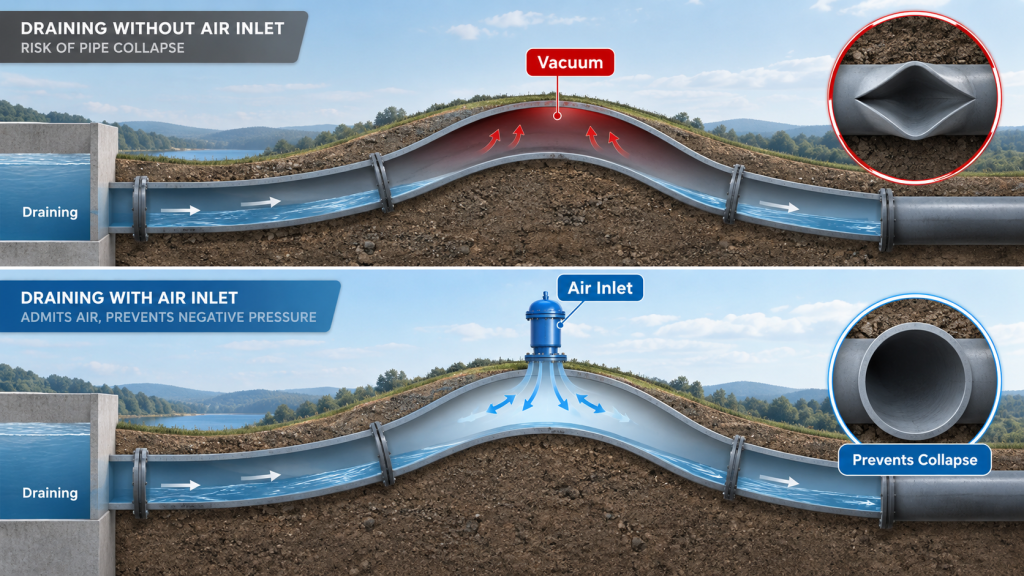
Fluid transmission networks operate under complex hydraulic gradients. While internal pressure capacity often dictates pipe selection, negative pressure events present an equally severe structural hazard. When liquid columns separate or drain rapidly without adequate atmospheric compensation, severe internal vacuum conditions develop, frequently leading to catastrophic pipeline collapse. Managing these transient phases requires robust air management infrastructure, specifically engineered air inlet service valves.
Understanding Vacuum Formation and Air Ingestion Dynamics
Vacuum generation in closed conduits typically occurs during rapid pipeline draining, pump trip events, or pipe bursts where the outflow rate exceeds the liquid supply rate. As the water column separates, sub-atmospheric pressures propagate through the system. Thin-walled steel, ductile iron, or plastic pipes that are structurally sound under positive internal pressure can buckle or flatten radially when subjected to external atmospheric loading unopposed by internal pressure.
To counteract this, piping networks require dedicated air inlet mechanisms capable of rapidly aspirating high volumes of atmospheric air into the conduit. This mass influx breaks the vacuum state, stabilizing internal pressure relative to the exterior and protecting the pipe wall from buckling failures.
Operational Functions of Air Valves in Water Systems
Modern fluid networks utilize combination air valves to handle three distinct phases of air management:
- Air Discharge During Filling: As a pipeline fills with water, large volumes of trapped air must be expelled through the high points of the system to prevent flow restrictions and pressure spikes.
- Air Release During Operation: Micro-pockets of air, released from solution as water pressure drops, accumulate at pipeline crests. These must be vented automatically in small volumes to maintain effective cross-sectional flow areas and reduce head loss.
- Air Inlet During Draining: When emptying the line or during a transient downsurge, large orifices open to admit air freely, preventing sub-atmospheric pressures.
For standard water lines and non-corrosive liquids operating up to 80°C, units such as the Vahid Combination Air Valve PN 10/16 are engineered to provide these integrated functions within a working pressure range of 0.3 to 16 bar.
Design Principles and Material Specifications
Selecting appropriate hardware for air inlet service requires rigorous evaluation of internal stresses, float responsiveness, and corrosion resistance. Quality combination air valves are typically manufactured in accordance with standards such as DIN 1074–P4, utilizing durable body materials like ductile iron GJS400 EN 1563 (DIN 1693) to withstand operational line pressures.
Internal buoyancy components must balance low weight with high mechanical resilience. For instance, advanced designs feature high-strength, anti-sediment polymer floats or AISI 316 stainless steel options. Dynamic internal engineering allows high-velocity air discharge up to 0.8 bar differential pressure, which prevents premature valve closure caused by high-speed air venting. Furthermore, integrated plastic screen baskets prevent direct contact between the automatic float and the cast body, ensuring smooth, unhindered operation.
Installation Best Practices and Maintenance Protocols
Correct placement is critical for effective air valve performance. Air inlet and release assemblies must be positioned at all high points along the pipeline profile, immediately downstream of control valves, and at changes in downward slope where air pockets naturally migrate.
Flange connections should adhere to standardized drilling patterns such as EN 1092-P2 (DIN 2501). Maintenance protocols should align with operational severity. While high-quality valves with epoxy powder or sunlight-resistant polyester coatings minimize maintenance overhead, systems carrying suspended particles require periodic inspection of internal floats, seals, and strainers. Regular servicing prevents sediment buildup that can compromise low-pressure sealing provided by soft rubber coatings on automatic valve floats.
Frequently Asked Questions
What causes a pipeline to collapse due to vacuum?
A pipeline collapses when rapid draining, line breaks, or pump shutdowns cause internal fluid separation, creating a negative pressure (vacuum) that exceeds the structural ring stiffness of the pipe wall against external atmospheric pressure.
How does a combination air valve differ from a standard air release valve?
A combination air valve integrates both large-orifice (air-vacuum) and small-orifice (automatic air release) functions into a single body, managing large air volumes during filling and draining while venting accumulated operational air pockets.
What are the material requirements for air valve bodies in municipal water lines?
Standard municipal water applications typically utilize ductile iron bodies conforming to EN 1563 (DIN 1693) GJS400, protected by epoxy powder coatings to resist environmental degradation.
At what pressure differential do combination air valves close during air discharge?
Quality dynamic designs, such as Vahid combination air valves, allow high-velocity air discharge up to a 0.8 bar differential pressure before the air stream forces the float to close, preventing premature closure.