
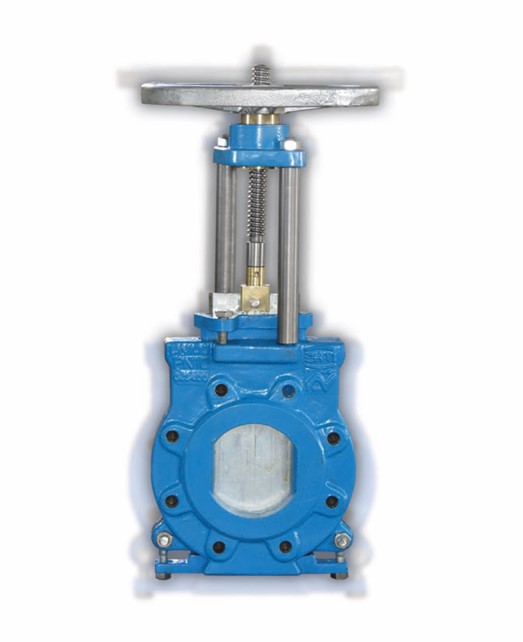
Technical Overview
Knife Valve PN 6/10 is an isolation valve used in industrial lines where viscous fluids, slurry, sludge, chemical sludge, sugar paste, waste streams or similar media may be present. The valve is designed for one-sided isolation and installation between two flanged pipes.
The product is used in food and drink industries, chemical industries, dough-making industries, high-viscosity liquid production lines, waste handling lines and thermal power plants. Its design includes full uplift movement to help passing solid materials, blade isolation by a packing layer and reduced contact between moving parts.
For installation, flange compatibility should be checked according to EN 1092-P2 / DIN 2501. Test pressure is specified according to EN 12266-P1. Final selection should always consider pressure rating, medium properties, suspended solids, operating temperature and the required isolation performance.
What Is a Knife Valve? Applications, Design and Selection Notes
Technical Specifications
| Pressure Rating | PN 6/10 |
|---|---|
| Connection Type | Installation between two flanged pipes |
| Operation Type | Handwheel operation |
| Seat / Seal | Packing layer for blade isolation |
| Coating | Color ordered by customer |
| Flange Standard | EN 1092-P2 / DIN 2501 |
| Test Standard | EN 12266-P1 |
Applications
- Food and drink industries
- Chemical industries
- Dough-making industries
- Paper mache and high-viscosity liquid production lines
- Clammy liquids and sugar paste
- Waste streams and chemical sludge
- Thermal power plants
Design and Operating Features
- One-sided isolation
- Installation between two flanged pipes
- Full uplift movement to help passing solid materials
- Blade isolation by a packing layer
- Minimum contact between moving parts
- Easy blade movement upward and downward without contacting the valve body
- Flange dimensions according to EN 1092-P2 / DIN 2501
- Test pressure according to EN 12266-P1
- Color ordered by customer
Standards and Testing
- PN 6/10
- EN 1092-P2
- EN 12266-P1
Installation Notes
- The valve is installed between two flanged pipes. Flange compatibility should be checked before installation according to EN 1092-P2 / DIN 2501. The valve should be positioned so that blade movement and packing access remain suitable for inspection and maintenance.
Maintenance Considerations
- Maintenance should focus on the blade movement, packing layer condition, sealing performance and the presence of solid deposits around the flow path. Moving parts should be inspected periodically to maintain smooth upward and downward blade operation.
Selection Notes and Limitations
- Final valve selection should consider pressure rating, fluid viscosity, suspended solids, operating temperature, flange compatibility and the required isolation performance. Material selection should be confirmed against the actual medium before use in corrosive or abrasive service.
FAQ
What is Knife Valve PN 6/10 used for?
Knife Valve PN 6/10 is used for isolation service in lines carrying viscous fluids, slurry, sludge, chemical sludge, sugar paste, waste streams and similar industrial media.
Can a knife valve be used with solid-containing media?
Yes. The catalog describes full uplift movement to help passing solid materials, which makes this valve suitable for media where suspended solids may be present.
How is Knife Valve PN 6/10 installed?
It is installed between two flanged pipes. Flange dimensions should be checked according to EN 1092-P2 / DIN 2501 before installation.
Which test standard is mentioned for this knife valve?
The catalog mentions test pressure according to EN 12266-P1.