
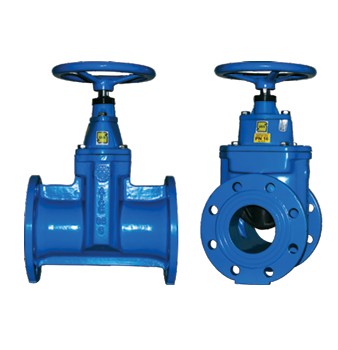
Technical Overview
Anti-Corrosion Rubber Wedge Gate Valves are designed for liquid flow on/off service in chemical industries, water purifier chlorination stations, municipal and industrial sewage, pools and a wide range of corrosive liquids with a maximum temperature of 80°C.
This valve type is available in PN10, PN16, PN25 and PN40 pressure classes. Anti-corrosion valve versions are available in Series F4 and Series F5, with sizes from DN50 to DN300. Dimensional specifications depend on the selected valve model.
Technical Overview
The valve is used where the required function is opening or closing the flow path. According to the catalog, this model is intended for corrosive liquid applications and selected operating conditions where the rubberized wedge, rubber parts, wedge nut and spindle need to be selected based on the liquid type and working conditions.
Applications
- Chemical industries
- Water purifier chlorination stations
- Municipal sewage
- Industrial sewage
- Pools
- Corrosive liquids up to 80°C
Design and Construction
The valve parts, spindle arrangement mechanism and sealing system are designed by AICC.
The valve can be serviced without removing it from the pipeline, and it is suitable for underground systems as a heavy duty valve.
Standards
- Designed and manufactured according to DIN 3352-4 and ISIRI 3363
- Flanges drilled according to EN 1092-2
- Other flange standards available upon request
- Face-to-face length according to EN 558-1 Series F4 and F5 / DIN 3202-1
- Spindle according to DIN 17440
- Epoxy electrostatic coating according to DIN 30677
- Hydrostatic test according to ISO 5208
Materials and Component Selection
The body, wedge and bonnet are made of ductile iron EN 1563 GJS400.
The spindle is made of stainless steel 1.4021 according to DIN 17440, with rolled thread and ultra-burnished sealing surface. The stem and thrust collar are produced as an integrated series.
For anti-corrosion applications, the rubberized wedge, all rubber parts, wedge nut and spindle are designed and selected based on the kind of liquid and operating circumstances for each application.
The catalog also mentions Viton Rubber, Special EPDM Rubber and Stainless Steel AISI 316 in relation to this anti-corrosion valve model.
Coating
Inside and outside surfaces are covered with a minimum 250 micron epoxy electrostatic paint coating according to DIN 30677.
Available Sizes
Anti-corrosion valves in Series F4 and Series F5 are available from DN50 to DN300.
Dimensional specifications depend on the specific valve model.
Hydrostatic Test
The valve is tested according to ISO 5208.
For PN10, the body test pressure is 15 bar and the seal test pressure is 11 bar.
For PN16, the body test pressure is 24 bar and the seal test pressure is 17.6 bar.
For PN25, the body test pressure is 37.5 bar and the seal test pressure is 27.5 bar.
Technical Summary
Anti-Corrosion Rubber Wedge Gate Valves are ductile iron gate valves for on/off service in chemical industries, chlorination stations, municipal and industrial sewage, pools and corrosive liquid applications up to 80°C. The valve is available in Series F4 and F5 from DN50 to DN300, with PN10, PN16, PN25 and PN40 pressure classes. Material and component selection for the rubberized wedge, rubber parts, wedge nut and spindle depends on the liquid type and operating conditions.
Related category: Gate Valves
Related article: What Is a Gate Valve?
Related product: Rubber Wedge Gate Valves Series F4 and F5
FAQ
What are Anti-Corrosion Rubber Wedge Gate Valves used for?
They are used for liquid flow on/off service in chemical industries, water purifier chlorination stations, municipal and industrial sewage, pools and corrosive liquid applications up to 80°C.
What pressure classes are available?
The catalog lists this valve model in PN10, PN16, PN25 and PN40.
What size range is available?
Anti-corrosion valves in Series F4 and Series F5 are available from DN50 to DN300.
What standards are mentioned for this valve?
The catalog mentions DIN 3352-4, ISIRI 3363, EN 1092-2, EN 558-1, DIN 3202-1, DIN 17440, DIN 30677 and ISO 5208.
How are the anti-corrosion components selected?
The rubberized wedge, rubber parts, wedge nut and spindle are selected based on the kind of liquid and operating circumstances for each application.